When most parents think of cavities, they imagine school-going children who love chocolates and candies. Very few expect a toddler who has just started exploring the world to develop severe tooth decay.
Unfortunately, this is exactly what happened to little Arjun.
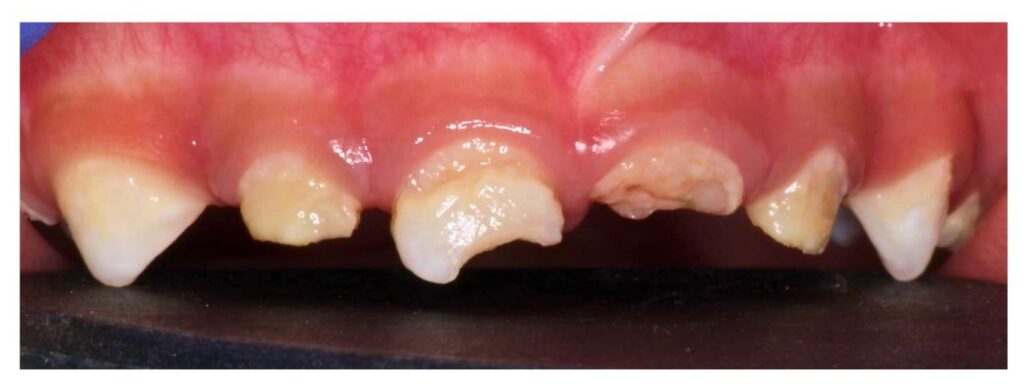
At only 1 year and 10 months of age, Arjun, visited Childhood Smiles with multiple severely damaged baby teeth. His upper front teeth had extensive decay, and his back teeth had also begun to break down. The damage was so advanced that many parents might assume the only option would be to remove the affected teeth.
Thankfully, that wasn’t the case.
With careful planning, advanced pediatric dental care, and a compassionate approach, our team was able to save his teeth, restore his smile, and help him return to eating, smiling, and growing comfortably. The treatment included pulpectomies and aesthetic crowns for the upper front teeth, protective treatment and crowns for the molars, restorative care, and fluoride application – all completed under IV sedation after appropriate pre-anesthesia assessment.
This is Arjun’s story.
Overview
Name: Arjun Kumar (Pseudo name for confidentiality purposes)
Gender: Male
Age: 1 Year and 10 Months
Treatment: pulpectomies and aesthetic crowns for the upper front teeth, protective treatment and crowns for the molars, restorative care, and fluoride application – under IV Sedation
Doctor: Dr. Debarchhana Jena
A Parent's Biggest Fear
For any parent, hearing that their two-year-old needs extensive dental treatment is overwhelming.
Questions begin racing through their minds.
“How did this happen?”
“Will my child lose all these teeth?”
“Is the treatment safe?”
“Will my child be in pain?”
When Arjun’s parents came to us, they carried these very concerns.
Their little boy was still a toddler, yet several of his baby teeth had already been severely affected by decay. Like many loving parents, they wanted the safest and most comfortable solution for their child.
What We Found During the Examination
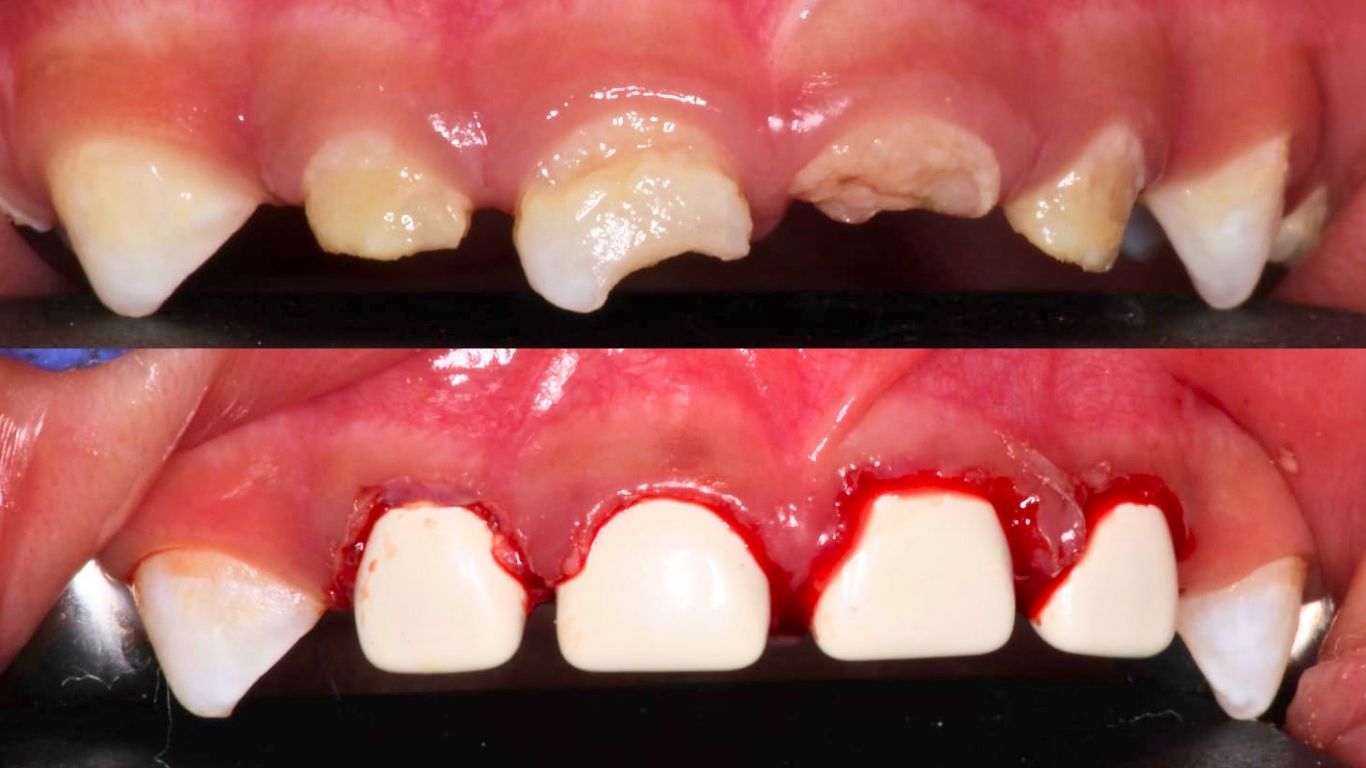
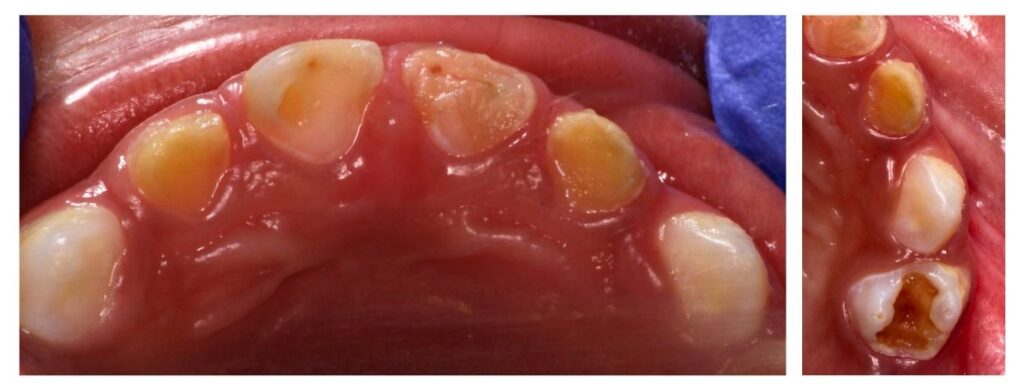
Our clinical examination showed that the upper front teeth had extensive destruction due to Early Childhood Caries (ECC) – a rapidly progressing form of tooth decay seen in infants and preschool children. The back teeth were also affected, with some requiring protection to preserve the healthy portion of the tooth. Early childhood caries can spread quickly through young teeth because baby teeth have thinner enamel than permanent teeth.
Several front teeth had lost a significant portion of their natural structure.
One of the molars had a deep cavity.
Without timely treatment, these teeth could eventually become painful, infected, or require extraction.
However, our goal in pediatric dentistry is always the same whenever possible:
Save the natural tooth.
Why Saving Baby Teeth Is So Important
One of the biggest misconceptions parents have is:
They’re only baby teeth. They’ll fall out anyway.
In reality, baby teeth perform several important functions.
They help children:
Eat comfortably
Learn clear speech
Smile confidently
Maintain proper jaw growth
Guide permanent teeth into their correct positions
Losing baby teeth too early may affect chewing, speech, and the way permanent teeth erupt later.
Whenever it is possible to preserve them, saving baby teeth is often the best option.
Planning the Best Treatment for Arjun
Because of Arjun’s young age and the amount of treatment required, completing multiple procedures over several appointments would have been difficult and stressful for him.
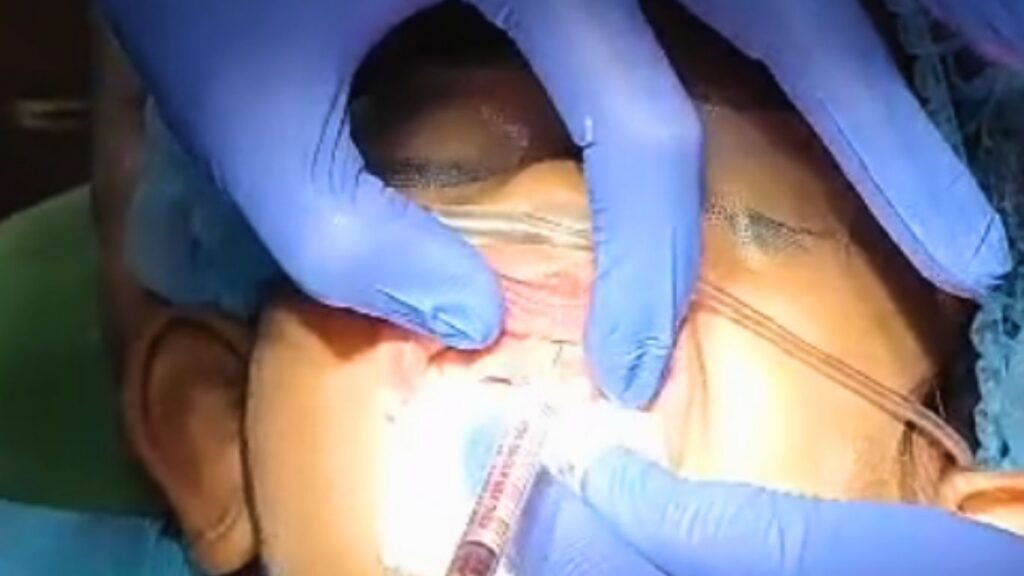
After carefully evaluating his condition and completing a Pre-Anesthesia Checkup (PAC), the treatment was planned under IV sedation. This allowed all necessary dental procedures to be completed comfortably in a controlled setting while minimizing stress for the child.
This approach also ensured that every tooth received the attention it needed in a single comprehensive treatment session.
Restoring Tiny Teeth, One by One
Every tooth required an individualized treatment plan.
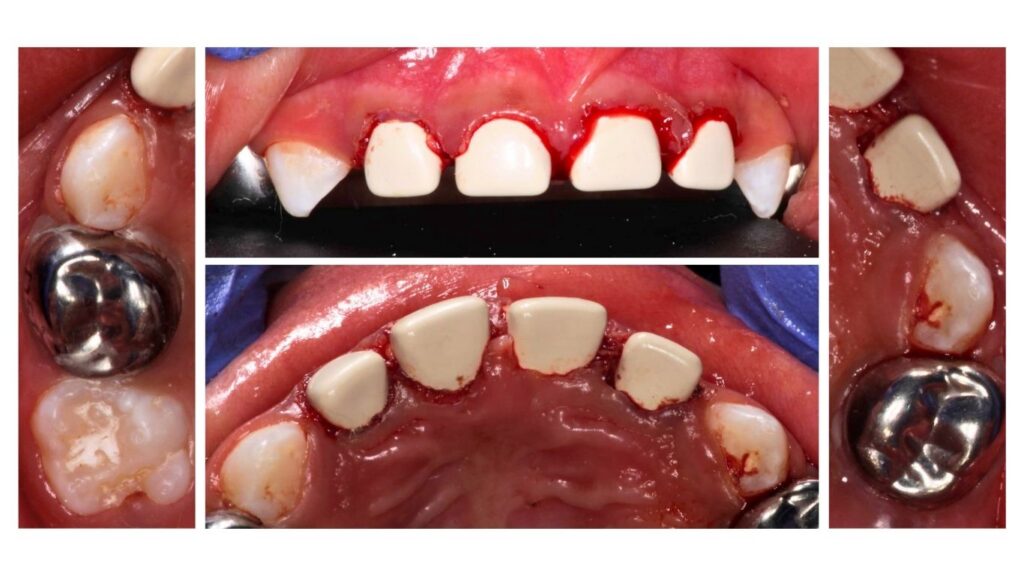
For the severely affected upper front teeth, we performed pulpectomy – a procedure that removes infected tissue from inside the baby tooth while preserving the tooth itself. Once treated, the teeth were rebuilt and restored with tooth-coloured aesthetic crowns, allowing them to look natural while protecting them during everyday use.
Some of the back teeth still had healthy tooth structure that could be preserved. Instead of removing more tooth than necessary, we used a conservative approach that included selective caries removal, indirect pulp capping, and stainless steel crowns. These crowns are widely used in pediatric dentistry because they are durable, long-lasting, and protect weakened baby molars until they naturally fall out.
One additional tooth was restored with a filling, and a full-mouth fluoride varnish application was completed to strengthen the enamel and help reduce the risk of future decay.
The Transformation
One of the most rewarding moments for every pediatric dentist is comparing the “before” and “after.”
The difference in Arjun’s smile was remarkable.
The severely damaged front teeth had been transformed into healthy-looking, natural-looking baby teeth.
The back teeth were protected with strong stainless steel crowns, allowing him to chew comfortably again.
Most importantly, his mouth was free from active disease.
The transformation wasn’t just cosmetic: It restored function and comfort.
And it gave this little boy the opportunity to continue growing with healthy baby teeth.
A Parent's Perspective
For us, clinical success is only one part of the story.
The true measure of success is how parents feel throughout their child’s journey.
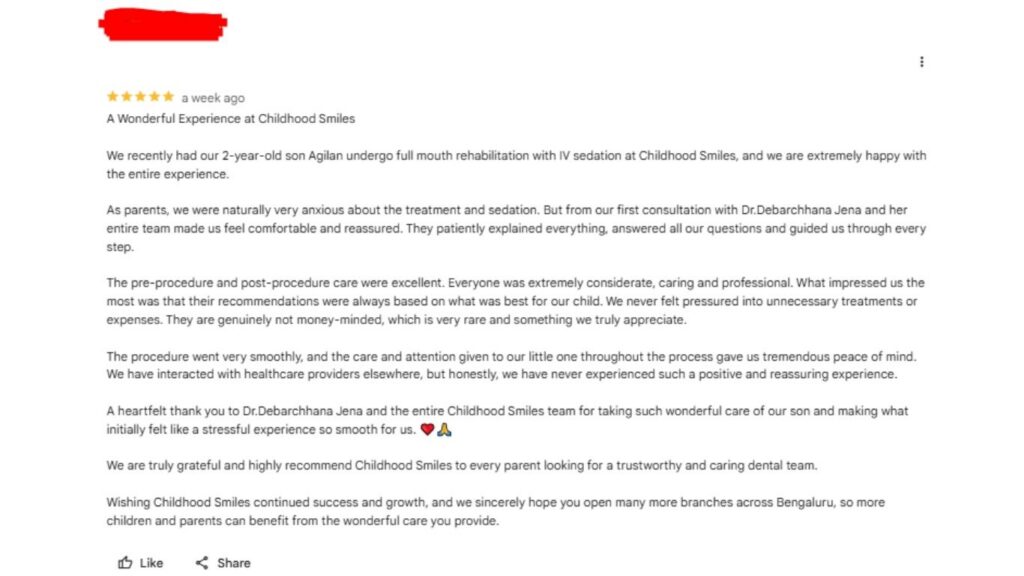
After Arjun’s treatment, his parents shared a heartfelt review describing their experience.
They spoke about the anxiety they initially felt regarding both the dental treatment and IV sedation. However, they appreciated how every step was explained in detail, how all their questions were answered patiently, and how they felt reassured throughout the process.
One statement particularly touched our team:
“Their recommendations were always based on what was best for our child. We never felt pressured into unnecessary treatments or expenses.”
They also described the care before, during, and after the procedure as smooth, professional, and compassionate, saying that the entire experience gave them tremendous peace of mind.
For us, this kind of trust is the greatest compliment we can receive.
What Arjun's Story Teaches Every Parent
This case carries an important message.
Early Childhood Caries can progress much faster than many parents expect.
The good news is that early intervention often makes treatment simpler.
Even when teeth appear badly damaged, they may still be saved by a pediatric dentist using appropriate techniques and evidence-based treatment planning.
Regular dental check-ups from the eruption of the first tooth, healthy feeding habits, reduced sugar exposure, good brushing practices, and timely professional care all play an important role in protecting young smiles.
Why Childhood Smiles?
At Childhood Smiles, every child is treated by pediatric dental specialists who understand that children are not simply “small adults.”
Their dental needs, behaviour, emotional comfort, and growth all require a specialized approach.
Our goal is always to provide evidence-based, child-friendly dental care while helping parents feel informed, confident, and supported throughout their child’s treatment journey.
Because every child deserves more than healthy teeth.
They deserve a healthy, happy smile.
If You Notice Any of These Signs, Don't Wait
If your child has:
White or brown spots on the teeth
Teeth that appear chipped or broken
Food getting stuck frequently
Tooth sensitivity or pain
Difficulty chewing
Swelling around a tooth
Don’t assume they will simply “grow out of it.”
An early visit to a pediatric dentist can often prevent small problems from becoming major ones.
Arjun’s smile reminds us of one simple truth:
Baby teeth may be temporary, but the care we give them can have a lifelong impact.